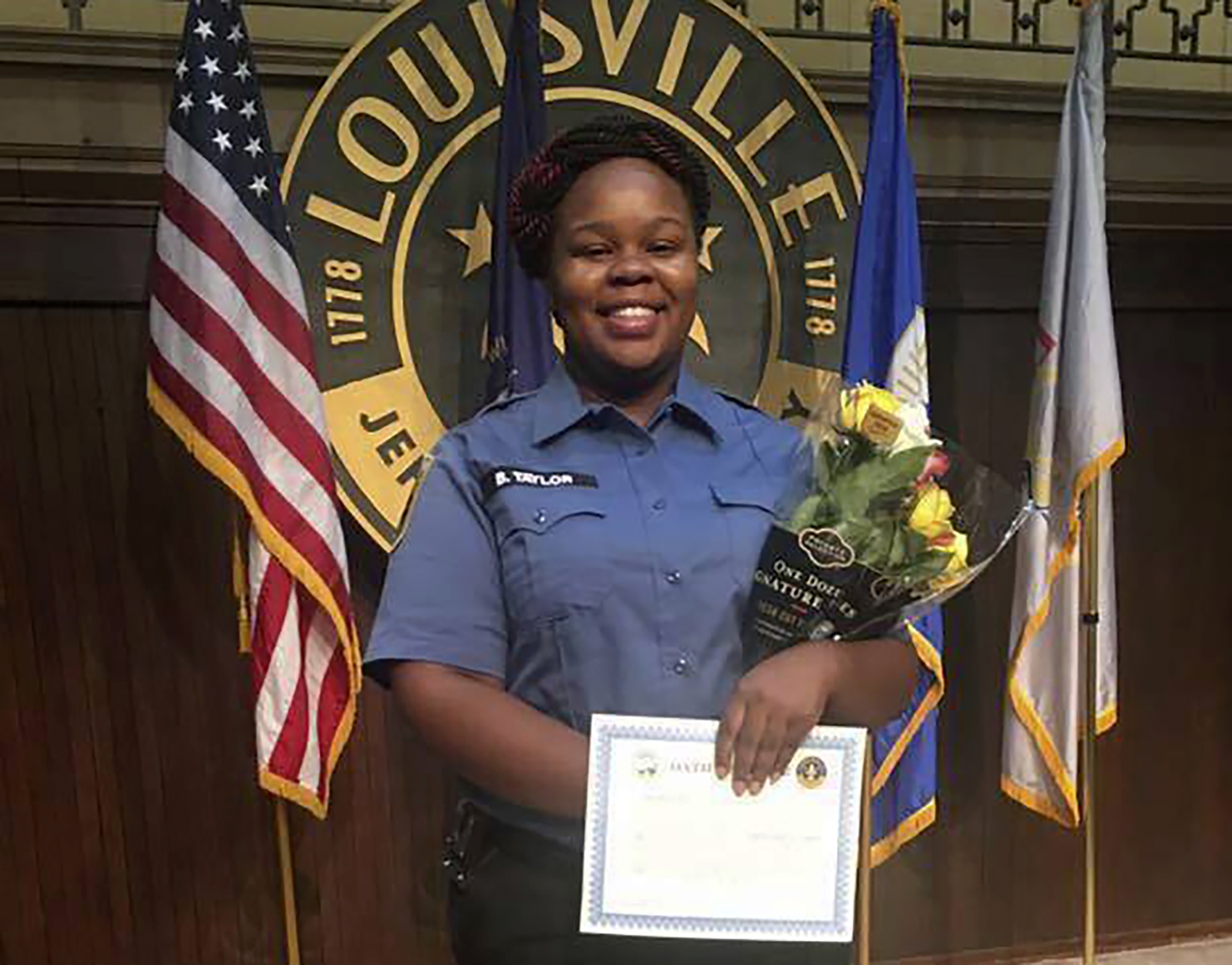
In a development that has drawn considerable scrutiny, the United States Department of Justice is advocating against a prison sentence for Brett Hankison, a former Louisville Metro Police Department detective. Hankison was previously convicted of deprivation of rights under color of law in connection with his actions during the ill-fated 2020 raid on Breonna Taylor’s residence, an incident that ignited a nationwide debate on policing practices and prompted a federal investigation into the Louisville force. This recommendation, outlined in a recent sentencing memo, suggests a desire for a resolution that avoids further incarceration for the former officer.
Hankison’s sentencing in November was a result of his actions during the disordered raid, during which he fired his weapon ten times into Taylor’s home. Lawyers highlighted that his bullets passed through a window and a sliding glass door, both covered by blinds and drapes, with a number of bullets going through walls into a neighboring apartment. Importantly, none of Hankison’s shots hit Breonna Taylor. The officers who fired shots that led to Taylor’s death were not indicted because their actions were seen as defensive fire after Taylor’s partner, Kenneth Walker, shot his gun when officers entered the apartment.
The memorandum for sentencing submitted by the Justice Department on a Wednesday night offered a detailed view regarding Hankison’s behavior. It mentioned that «there may be differing opinions about whether Hankison’s actions initially amounted to a seizure under the Fourth Amendment.» Additionally, the document claimed that «incarceration is not necessary to safeguard the public from the defendant.» This stance is significant in light of a judge’s decision in February, which found there was enough proof for a jury to conclude that Taylor was alive when Hankison discharged his first five shots through the bedroom window.
The Department of Justice’s recommendation specifically requests a sentence of one day of incarceration, a duration that corresponds precisely to the time Hankison already spent in custody following his initial booking on charges. A point of contention for some observers is the fact that this sentencing memo was not endorsed by career line prosecutors within the Justice Department’s Civil Rights Division. Instead, it bears the signature of Robert J. Keenan, a senior counsel in the Civil Rights Division who held an appointment during the Trump administration. Keenan has been previously associated with the Justice Department’s efforts to overturn a jury verdict that found a former Los Angeles County deputy guilty of a felony in an excessive force case, adding another layer to the discussion surrounding the department’s stance.
The context of this recommendation also involves the significant transformations within the Justice Department’s Civil Rights Division. Since January, the division has undergone substantial overhauls in both policy and personnel, leading to a notable exodus of career professionals. This backdrop has fueled speculation regarding the influence of political appointments and policy shifts on the handling of sensitive cases like Hankison’s.
In the sentencing memorandum, the Justice Department also highlighted the atypical aspects of this case, pointing out that it «has no record of another instance where a police officer was prosecuted for violating another individual’s rights under the Fourth Amendment by returning gunfire and not causing harm to anyone.» This comment seeks to place the legal uniqueness of this case in context, which may set it apart from other legal actions concerning police misconduct.
The document also emphasized the lengthy legal battle to achieve a conviction of Hankison, pointing out that «two federal trials were eventually required to reach a unanimous guilty verdict.» Furthermore, «the jury found guilty on just one count,» even though the components of the charge and the underlying behavior were «essentially identical» across several counts. Hankison was previously found not guilty on a state charge connected to the incident, before the federal case.
In this case, several legal actions were taken against defendant Hankison, with only one of three juries — the final one — determining his guilt based on these circumstances, and even then, it was solely for one charge,» the memo clarified. Regardless, the Justice Department expressed its regard for the jury’s decision, anticipating that it would «almost certainly guarantee that defendant Hankison never works as a police officer again and will also probably ensure that he never legally owns a firearm again.» This indicates that even without further imprisonment, the conviction has serious career and personal impacts for Hankison.
The proposal for sentencing by the Justice Department hasn’t been universally embraced. Samantha Trepel, who previously worked in the Civil Rights Division of the Justice Department, voiced significant opposition in a post on LinkedIn. Trepel specifically remembered that during the raid, shots fired by Hankison nearly struck a sleeping infant, missing by around two feet. She described the Justice Department’s suggestion as an «obvious, last-minute political meddling in a case handled by unbiased, veteran career prosecutors who secured this verdict before an all-white jury of Kentucky residents and a Trump-appointed judge.» Her remarks indicate a profound unease among some within the legal field regarding the perceived political motives behind the sentencing proposal, particularly as it seems to deviate from what might be anticipated in a case concerning violation of civil rights.
Hankison is scheduled for sentencing on July 21. The judge overseeing the case will ultimately determine whether to accept the Justice Department’s recommendation or impose a different sentence. The decision will undoubtedly be closely watched as a gauge of accountability in high-profile police misconduct cases and the ongoing debates surrounding justice and law enforcement in the United States.